
The larger and more interconnected a company or organization is, the more complex and diverse its underlying system landscape tends to be. It is rare for a corporate group to rely exclusively on a single back-end system, as in most cases, distinct IT structures have developed over the years within the various parts of the group. Gradual software rollouts also mean that new and old systems are in operation simultaneously. That’s why it’s a major advantage when a document management system works seamlessly even in a changing multi-system landscape. Using ESCRIBA Enterprise Document Services (EDS) as an example, we’ll explain how a DMS can be integrated into a multi-system landscape that uses various backend systems—such as SAP HCM, SAP SuccessFactors, Workday, or Dayforce—and where data is stored both on-premises and in the cloud.
Stay up to date on human resources and digital transformation, and follow ESCRIBA on LinkedIn.
Estimated reading time: 11 minutes
Overview
- Why a Document Management System Is Indispensable
- How ESCRIBA EDS Integrates Seamlessly into Multi-System Environments
- The ESCRIBA Integration Server: The Data Hub for Parallel Systems
- Dynamic document generation instead of static templates
- A wide range of integration options for any system environment
- SAP Certification: Reliability Even in Complex SAP Environments
- Workday Integration: “Built on Workday”-Certified Apps
- No programming required—yet maximum flexibility
- Enterprise-Level Governance, Compliance, and Security
- Use Cases – The REWE Group and ENERCON as Reference Examples
- Conclusion: Well-positioned for the future with ESCRIBA’s DMS
Why a Document Management System Is Indispensable
Every company generates numerous documents every day. In large corporations, this number can quickly reach hundreds or even thousands per day. Typical documents include employment contracts, performance reviews, certificates, quotes, and contracts with service providers. A document obligates the parties involved to take specific actions and establishes legal relationships. Anyone who creates a large number of such documents in different contexts and with varying circumstances is familiar with the challenge: The content must always meet operational and legal requirements. It must be consistent with the data in the backend systems. The solution to this is a document management system (DMS) that, ideally, can also be integrated into a complex multi-system landscape.
The requirements are particularly high in the HR field. Employment contracts, references, and certificates are legally sensitive, highly individualized, and must unambiguously comply with regulations such as the GDPR. Different templates, manual post-processing, and a lack of standardized guidelines lead to errors, inconsistencies, and significant time loss in many companies. The more complex HR processes are, the greater the compliance risks and efficiency losses become.
A professional document management system (DMS) solves exactly these problems. It brings order, automates document processes, and forms the backbone of a fully digital document strategy. Companies with more than 500 employees benefit disproportionately from the economies of scale offered by a high-performance DMS—from structured document creation and multi-level approval workflows to legally compliant archiving. The result is not only a reduction in administrative overhead but also a noticeably higher quality and greater legal compliance of the documents produced.
How ESCRIBA EDS Integrates Seamlessly into Multi-System Environments
Enterprise IT is rarely a monolithic system. Established system landscapes with on-premises solutions such as SAP ERP or SAP HCM coexist with cloud-based solutions like SAP SuccessFactors, Workday, and Dayforce. Added to this are specialized tools for applicant tracking, payroll, and time and attendance management. As a result, data is scattered across various systems. Often, the good old Excel spreadsheet—stored locally—is also used. And yet, all of this scattered data must ultimately be consolidated into a single, error-free, and legally compliant document.
ESCRIBA Enterprise Document Services (EDS) was developed specifically for this scenario. What sets it apart is that, while most other systems are optimized for specific management systems, ESCRIBA can be seamlessly integrated into virtually any existing system landscape. This makes EDS not only an ideal multi-system solution but also a future-proof investment. Its wide range of interfaces ensures a high level of integration now and in the future.
The ESCRIBA Integration Server: The Data Hub for Parallel Systems
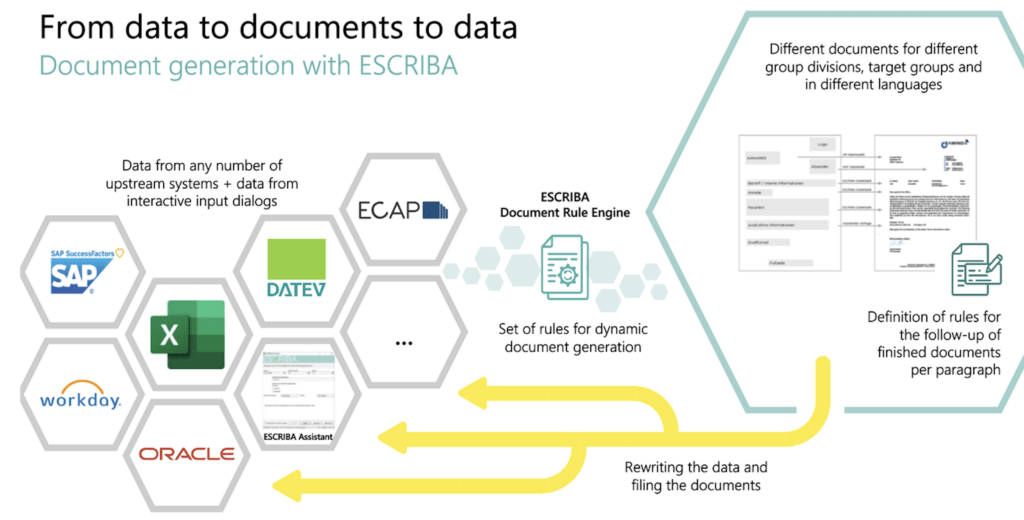
The technical backbone of the ESCRIBA platform is the ESCRIBA Integration Server (EIS) —a sophisticated multisystem solution for integrating ESCRIBA applications into existing backend systems such as SAP HCM, SAP SuccessFactors, Workday, Dayforce, or Oracle. As a data hub, the EIS can access all necessary data—ideally even bidirectionally, provided the backend system’s API allows it. This allows data to be read in parallel from multiple existing system environments as needed, consolidated, and—in the case of a bidirectional connection—written back as well.
The key benefit: All workflows run smoothly without media breaks or duplicate data entry, while the master data in the connected backend systems always remains up to date. Following the single-source-of-truth principle , data that has been modified in an ESCRIBA application can be updated simultaneously in the corresponding backend data record—provided it is configured accordingly.
What clearly sets ESCRIBA apart from other DMS solutions is that the EIS not only serves as a data hub but also enhances the functionality of the existing system. It provides the components needed for document generation and ensures cross-system temporary storage. And it does so regardless of whether on-premises, cloud, or hybrid scenarios are used.
Dynamic document generation instead of static templates
Traditional DMS solutions use static Word templates. However, this approach quickly reaches its limits when dealing with complex, data-driven documents in multi-system environments. ESCRIBA, on the other hand, relies on dynamic document blueprints. These blueprints specify which elements should appear in which positions and which data sources should be used for them. Data of various types from any connected system can be utilized, including text elements, numerical values, images, and more.
The content is compiled directly during generation based on predefined logic and the data used. Missing data that is not stored in any system can be manually added through logically structured assistance prompts. The result is highly customized documents that are automatically tailored to the specific circumstances. They are always complete and error-free.
A wide range of integration options for any system environment
The ESCRIBA Integration Server offers a wide range of integration options to support virtually any conceivable IT environment:
- For HCM systems such as SAP SuccessFactors, Workday, and Dayforce, there are pre-built connectors for quick and easy integration.
- For other systems, such as applicant tracking systems (e.g., d.vinci), integration options are available via REST API.
- Via an SQL adapter (based on JDBC): Data is read directly from SQL databases such as Oracle.
- File Adapter: Importing data from uploaded Microsoft Excel files.
- Web Services: Integration with other applications, such as Kidicap or ServiceNow.
In addition, the AI-based no-code and low-code platform ESCRIBA Enterprise Agent Network (EAN) can be used to develop applications that are also connected to existing systems and services via EIS. The possibilities for deployment and expansion are therefore virtually limitless.
SAP Certification: Reliability Even in Complex SAP Environments
For companies that use SAP, the SAP certification of the ESCRIBA Integration Server is a strong indicator of quality. This is because the EIS has now been certified by SAP for the fifth consecutive time. The certification is renewed annually and confirms that the ESCRIBA Integration Server 2.0 enables seamless and reliable data exchange on the SAP Business Technology Platform (BTP). In addition, ESCRIBA solutions are listed in the SAP Store.
In practice, this means that companies using both SAP ERP or SAP HCM on-premises and SAP SuccessFactors in the cloud can connect both systems in parallel via the EIS and consolidate data from both environments into a single document. A hybrid system landscape is therefore no longer an obstacle, but rather a manageable task.
Workday Integration: “Built on Workday”-Certified Apps
For Workday environments, there are two apps available that offer the coveted certificate “Built on Workday” and are available directly in the Workday Marketplace
The ESCRIBA Document Automation Connector enables Workday users to create and edit documents directly from within Workday—without switching systems. Content, layout, and branding are automatically adapted to meet the company’s requirements. Global localization support for multiple languages and an integrated signature manager for e-signatures across multiple providers are included.
The ESCRIBA eFile Automation Connector supports the configuration of the eFile connection with Workday: Workday documents can be moved—either on an ad hoc basis or automatically—to the appropriate folder within the electronic personnel file. The application is highly configurable and also accommodates scenarios in which employees move between different jurisdictions.
No programming required—yet maximum flexibility
What makes implementing ESCRIBA in multi-system environments particularly attractive is that the entire integration process does not require extensive software development. Once the technical connection has been established, the required data fields from the respective APIs are linked via configuration in the connector—a straightforward and simple process. Customers can carry out the integration process on their own or with support from ESCRIBA.
Behind this is the ESCRIBA ECAP NLC|AI platform —a cutting-edge no- and low-code|AI technology that enables customization without developer teams. Companies can configure templates, rules, or interfaces themselves, allowing them to respond quickly to new requirements or regulatory changes. The ESCRIBA Agent Network (EAN) further accelerates project development through reusable functional modules powered by artificial intelligence.
Enterprise-Level Governance, Compliance, and Security
Another aspect that makes ESCRIBA indispensable in complex system landscapes is its sophisticated document governance concept. ESCRIBA is the only DMS that offers multi-tiered system landscapes, including recovery and HotSwap stages. Thanks to its powerful transport system, time-critical changes can be mitigated, rule-based texts can be extensively tested, and targeted approvals can be granted. Only perfect and verified document blueprints make it from development through quality assurance into the production system.
The ESCRIBA domain and authorization concept governs collaboration among different legal entities or departments and determines who is authorized to create or access which documents—down to the level of individual text blocks or clauses. All processes can be precisely controlled through person- and role-based permissions. Role-based access concepts and European hosting options ensure that the processing of personnel data remains GDPR-compliant at all times.
Use Cases – The REWE Group and ENERCON as Reference Examples
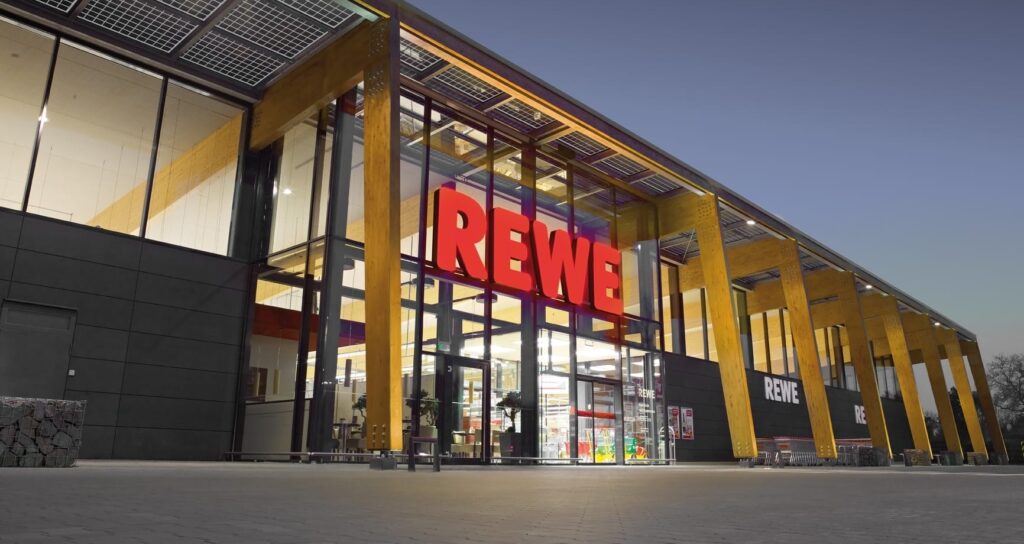
Successful use cases demonstrate that ESCRIBA truly shines when system landscapes are particularly complex. The REWE Group relies on a combination of SAP HCM and SAP SuccessFactors: Previously, differing templates, system landscapes, and manual processes led to high administrative burdens and a lack of standardization. With ESCRIBA Enterprise Document Services, all HR documents were centralized, automated based on rules, and integrated into both SAP systems—the result is a seamless, digital end-to-end process for group-wide HR document creation.
“One of ESCRIBA’s greatest strengths is its ability to manage diverse and complex documents in a clear and straightforward manner. Thanks to its deep integration with SAP HCM and SAP SuccessFactors, we are able to track the entire employee lifecycle at our company along with the corresponding documents,” confirms Joachim Pleiß, Head of HR Technology & Solutions at the REWE Group.
At ENERCON , success was particularly easy to measure in numbers. The process for drafting employment contracts was reduced from 6.25 hours to just 45 minutes. This translates to a 78 percent faster processing time, a 95 percent increase in the digitization rate, and a savings of over 900 hours of work.
Conclusion: Well-positioned for the future with ESCRIBA’s DMS
When implementing a document management system, the question isn’t “Which system are we using right now?” but rather “Which system will we be using in five or ten years?” System landscapes are constantly changing. For example, companies switch from SAP HCM to SAP SuccessFactors, migrate from on-premises to the cloud, supplement their core HCM with specialized tools, or implement new systems in parallel.
Anyone who chooses a document management system tied to a specific backend system exposes themselves to a high risk of migration. Those who choose ESCRIBA, on the other hand, are investing in a multi-system-compatible and therefore future-proof solution: The ESCRIBA Integration Server can connect to multiple systems—such as SAP HCM, SAP SuccessFactors, Workday, Dayforce, and Oracle—simultaneously. The data is consolidated into a single document. A system change therefore does not require restarting document processes, but merely reconfiguring the interfaces.
SAP certification, the “Built on Workday” certificate, and REST API compatibility with other systems ensure this is an investment in the future. Groundbreaking no- and low-code AI technology, which enables customizations without developer teams, along with the AI-powered ESCRIBA Agent Network (EAN), unlock unprecedented efficiency potential. With ESCRIBA EDS, companies thus gain much more than just a modern document management system for their multi-system landscape. They gain a solution for their IT future.
- Optimize and automate documents in SAP SuccessFactors – here’s how to do it with ESCRIBA
- Optimize and Automate Documents in Workday—Here’s How!
- The Best Document Management System (DMS) of 2026 – A Software Comparison
- Digital Document Management
- 7 Tips – What to Look for in a Document Management System