
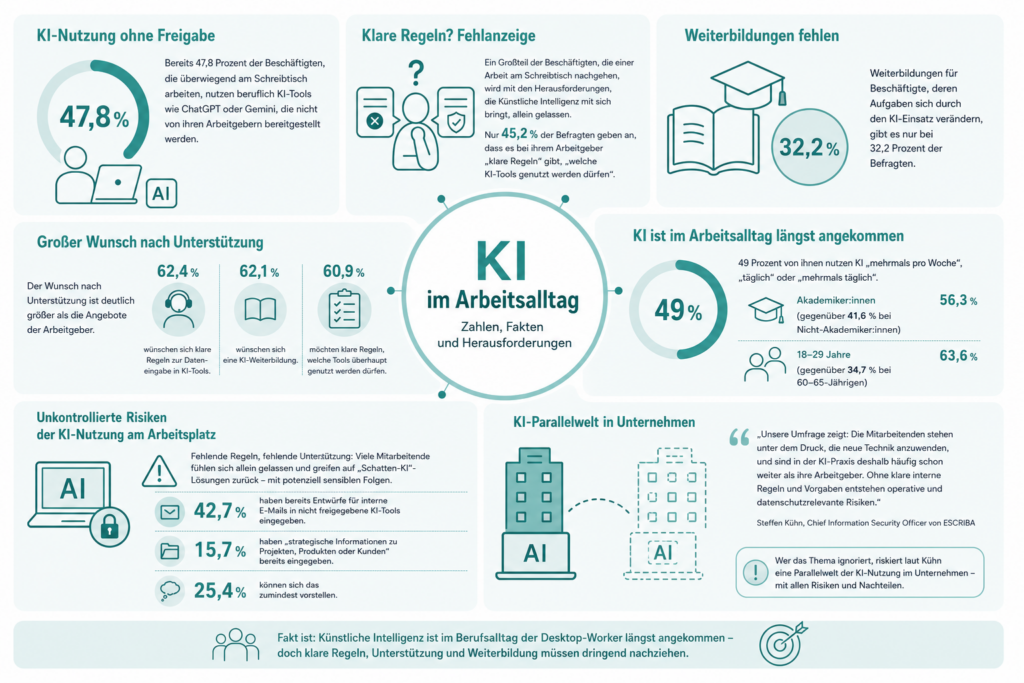
According to a survey by ESCRIBA, 47.8 percent of desktop workers use AI tools such as ChatGPT or Gemini for work purposes that are not provided by their employers. This is just one of the fascinating findings from the new ESCRIBA white paper on AI use in the workplace. For this study, the market research institute Bilendi surveyed 1,037 employees in Germany—most of whom work at a desk—in June 2023 on behalf of ESCRIBA.
Follow ESCRIBA on LinkedIn to stay up to date on digital transformation, AI, and human resources.
The Use of AI in the Workplace Without Rules or Oversight
A large proportion of employees who work at a desk are left to deal with the challenges posed by artificial intelligence on their own. For example, only 45.2 percent of respondents confirm that their employer has “clear rules” regarding “which AI tools may be used” (percentage of responses “Strongly agree” or “Somewhat agree”). Such rules are also lacking for entering data into AI tools (45.8 percent). Training programs for employees whose job responsibilities are changing due to the use of AI are available at only 32.2 percent of the companies surveyed.
A Futile Plea for Support
However, the demand for support among desktop workers is significantly greater than what employers are offering. According to the survey, 62.4 percent want clear rules for data entry into AI tools. Additionally, 62.1 percent of respondents would like AI training. A majority also wants clear rules regarding which tools are actually permitted for use (60.9 percent). Thus, the vast majority of employees wants comprehensive support from their employers. However, only a minority benefits from the measures mentioned.
AI has long since become part of everyday life
Yet artificial intelligence has long since become part of the daily work routine for desktop workers: 49.0 percent of them use AI “several times a week,” “daily,” or “several times a day.” Its use is particularly widespread among college graduates (56.3 percent compared to 41.6 percent among non-college graduates) as well as among younger workers aged 18 to 29 (63.6 percent compared to 34.7 percent among employees aged 60 to 65).
Research and Writing
AI is most commonly used for researching information. In fact, 71.4 percent of respondents said they use it “frequently” or “occasionally” in this context as part of their daily work. In second place is the creation or editing of texts and documents (65.5 percent). By contrast, only a minority—28.5 percent—feel confident creating and using AI agents. Office workers place the greatest trust in AI for text-related applications such as optimizing spelling and grammar. 62.2 percent have “very strong” or “somewhat strong” confidence in AI in this area. For the stylistic revision of texts, the figure is 59.3 percent. With regard to “automation (without direct review during the process),” trust is significantly lower at 30.1 percent.
Uncontrolled Use and Risks
A lack of rules and support: The resulting reliance on “shadow AI” solutions by nearly half of employees poses risks. When users of unofficial AI solutions are asked what data they have entered into these unofficially provided tools, clear risks become apparent. Entering sensitive company data into unauthorized AI tools is not a marginal phenomenon.
Entering Sensitive Data
42.7 percent of the surveyed “shadow AI” users have at some point entered drafts of internal emails into AI tools not provided by their employer, such as ChatGPT or Gemini. Another 27.4 percent can at least imagine doing so. “Strategic information about projects, products, or customers” has already been entered by 15.7 percent, and another 25.4 percent can at least imagine doing so. The entry of customer data (12.9 percent / 15.9 percent), HR or applicant data (12.3 percent / 17.5 percent), and financial data (9.5 percent / 18.1 percent) also shows high figures.
The AI Parallel World in Business
“Our survey shows that employees are under pressure to adopt the new technology and are therefore often further along in their practical use of AI than their employers. Without clear internal rules and guidelines, operational and data protection risks arise,” says Steffen Kühn, Chief Information Security Officer at ESCRIBA: “Those who ignore this issue risk creating a parallel world of AI use within the company—with all the associated risks and drawbacks.”
About ESCRIBA AG
ESCRIBA AG supports leading companies in the automation and digitization of HR processes. With its NLC|AI platform ECAP, ESCRIBA ranks among Europe’s technology leaders. The platform enables the comprehensive and compliant use of artificial intelligence within companies. It supports the setup and orchestration of AI agents and agent networks, while remaining independent of individual AI models to avoid dependencies and cost risks. The particular strength of ESCRIBA’s technologies is evident in the areas of document generation (DocGen), document management and archiving (digital personnel files), and process automation using AI (Enterprise Agent Network). ESCRIBA’s HR software modules can be operated and used independently or deeply integrated with SAP HCM, SAP SuccessFactors, Workday, Dayforce, Oracle, and IBM. Our clients include DAX 40 and MDAX companies, many international corporations from the Global Fortune 500, and public sector clients.
www.escriba.de