Following the digitization of human resources, the AI transformation is now on the horizon. While the first step involved digitizing HR documents to reduce bureaucracy, the focus is now on making this data accessible to AI agents so they can take on tasks in the HR department. But what exactly does the use of AI look like in day-to-day work? We present five practical AI use cases in HR and show how an advanced AI platform makes these scenarios technically possible.
Follow ESCRIBA on LinkedIn to stay up to date on HR digitization, AI transformation, and software solutions for human resources.
Estimated reading time: 10 minutes
Overview
- AI in Everyday Work: Current Situation and Urgent Need for Action
- Technological Basis: ESCRIBA Enterprise Agent Network (EAN)
- Use Case 1: File Validation – AI-Powered Quality Assurance for Digital Personnel Files
- Use Case 2: Knowledge Base and HR Assistants – Making Policies Actionable
- Use Case 3: Inbound Processing – Intelligent Routing and Automatic Replies
- Use Case 4: Process Support – AI for HR Business Partners
- Use Case 5: Self-Service HR Agent
- Conclusion on AI in Day-to-Day HR Work
AI in Everyday Work: Current Situation and Urgent Need for Action
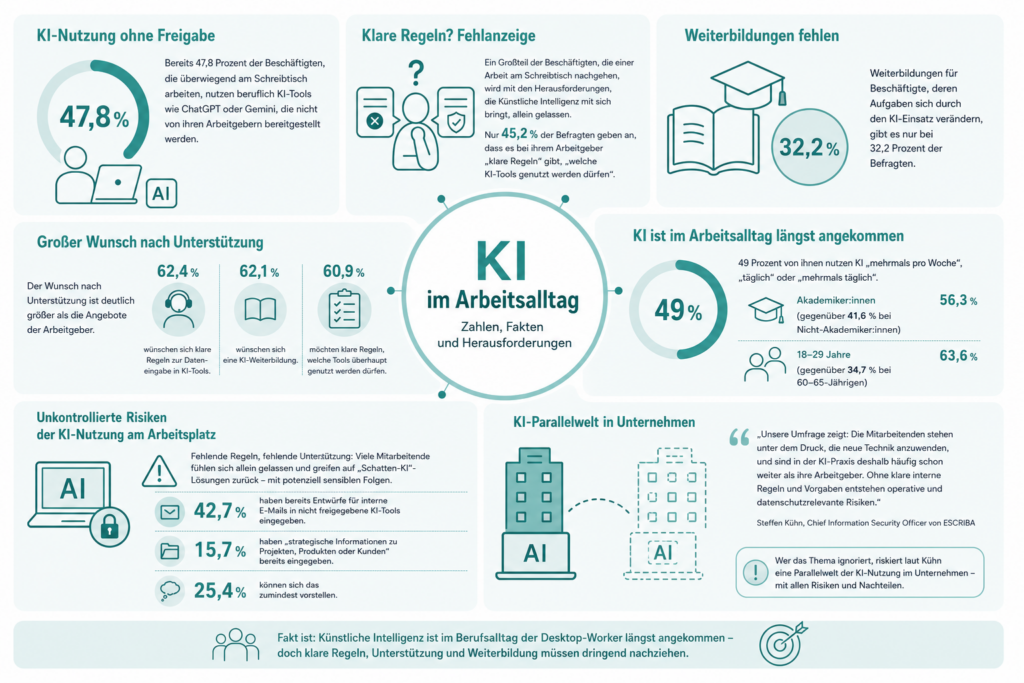
The ESCRIBA study on AI use in the workplace makes it clear: AI has long since become part of the daily work routine for desktop workers. 49 percent of respondents use AI “several times a week,” “daily,” or “several times a day,” primarily for research and writing tasks. At the same time, 47.8 percent use AI tools such as ChatGPT or Gemini for work that are not provided by their employer—a form of “shadow AI” that carries operational and data privacy risks.
However, employees want clear rules and support: More than 60 percent are calling for guidelines on data entry into AI tools, on the selection of approved tools, and on AI training. Dr. Juergen Erbeldinger, founder and CEO of ESCRIBA, emphasizes in an interview with SAATKORN that employees “are under pressure to use the new technology,” while companies are lagging behind in terms of governance and infrastructure.
This is exactly where HR software with AI capabilities comes in: It enables defined AI use cases in the HR field to be utilized in compliance with regulations, rather than allowing uncontrolled parallel systems to emerge. “The true potential of AI only unfolds when I can use, analyze, and evaluate AI-supported data in a secure environment. This requires connections to the data systems used in the respective field of work—and corresponding data quality,” explains Dr. Juergen Erbeldinger. AI-powered automation platforms, such as the ESCRIBA Enterprise Agent Network (EAN), serve as the foundation for this.
Technological Basis: ESCRIBA Enterprise Agent Network (EAN)
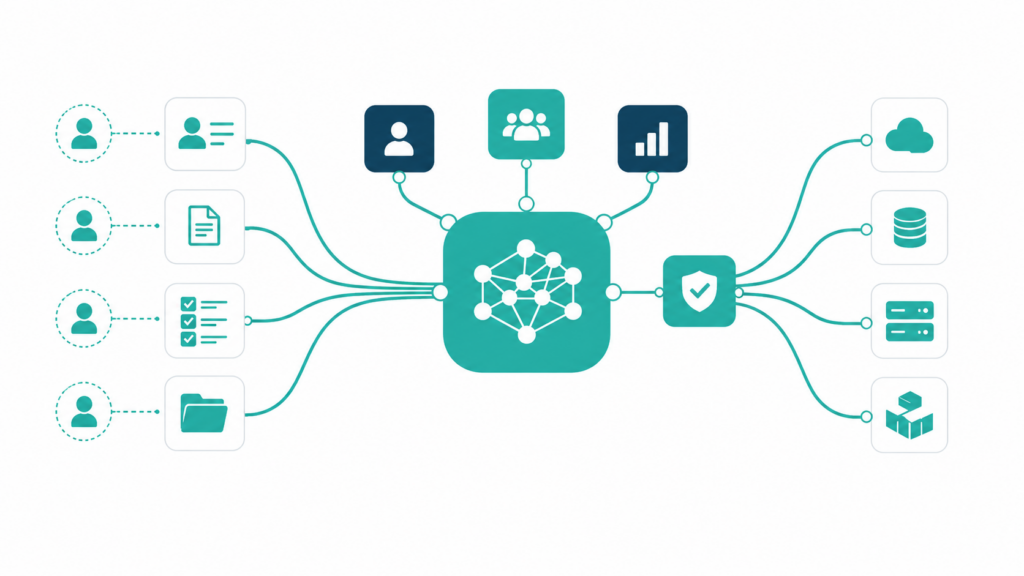
The ESCRIBA Enterprise Agent Network (EAN) is an automation platform that enables the creation of AI-powered agents. It is used for the module-based programming of data flows in HR backend systems. Using a graphical editor, reusable function blocks (nodes) are assembled into agent networks (graphs) that can map out complete HR workflows. There are two main types of nodes: connectors for integrating external systems such as SAP HCM, SAP SuccessFactors, or Workday, and logic blocks for business rules, data processing, and AI functions.
AI nodes integrate large language models (LLMs) directly into workflows. Through the Model Context Protocol (MCP), external AI models can dynamically access graphs and nodes. EAN is multi-tenant and provides a node-level audit trail. These are key requirements for HR software with AI capabilities in regulated environments. The AI agents created on this basis can be linked to ESCRIBA’s NLC|AI platform, ECAP, while remaining independent of individual AI models. This ensures data sovereignty and data protection.
Use Case 1: File Validation – AI-Powered Quality Assurance for Digital Personnel Files
Real-World Example
A typical AI use case in human resources is automated file validation. The goal is to ensure that all documents contained in a personnel file are correctly assigned and that the file does not contain any documents that are unrelated to the employee or have been filed incorrectly.
To this end, the documents are scanned using AI, their content is analyzed, and they are compared with the expected document types for the respective file. Documents that cannot be clearly assigned or whose content does not match the file are automatically transferred to a so-called “clearing box” and made available for further review.
This approach ensures that the accuracy of personnel files can be verified efficiently and at scale. For employees, this reduces the effort required for coordination and minimizes uncertainty regarding document storage. At the same time, the HR department benefits from significantly less manual verification work and a consistently audit-compliant filing system.
Technical Approach
During file validation, EAN links connectors to the digital personnel file with AI logic modules for document analysis. A graph loads an employee’s documents, classifies them using AI, checks their completeness and plausibility against stored rules and guidelines, and writes the results back to the HR system. AI nodes utilize semantic search and RAG functions (content generation supplemented by information retrieval) to determine, for example, whether a specific contract attachment is missing or whether a document is formally correct.
Use Case 2: Knowledge Base and HR Assistants – Making Policies Actionable
Real-World Example
An employee asks, “What are the rules for working remotely two days a week?” The HR assistant searches the relevant company policy, extracts the relevant passages, and provides a clear answer with a reference to the original document. Survey data collected by ESCRIBA shows that employees place particular trust in text-based AI applications, such as those for spelling and style optimization. This is precisely where the HR assistant comes in, extending this capability to policy-based responses. HR software with AI capabilities thus provides reliable information, reduces room for interpretation, and minimizes the need for HR to provide individually tailored responses.
Technical Approach
ESCRIBA uses vector databases and AI nodes to build a knowledge base consisting of policies, operating agreements, and process documentation. Documents are indexed, their content is made semantically searchable, and they are combined with RAG mechanisms to ensure that answers from the knowledge base are always provided with a source citation. The HR Assistant is an AI agent that is integrated via chat interfaces and accesses this knowledge base through tool calling.
Use Case 3: Inbound Processing – Intelligent Routing and Automatic Replies
Real-World Example
The goal is to efficiently classify incoming documents, file them correctly in the respective personnel files, and immediately trigger the appropriate follow-up processes. In this process, incoming documents are scanned using AI, analyzed for content, and automatically assigned to a document type and a specific digital personnel file based on defined criteria. Based on this, the documents are filed in the appropriate system in an audit-compliant manner.
At the same time, the AI initiates the appropriate HR workflow. For example, a submitted birth certificate can automatically update master data and trigger processes such as parental leave, maternity leave, or child allowances. In addition, a context-specific response is generated for the employee, such as a confirmation or informational email. This automation significantly shortens processing times, reduces manual effort, and ensures consistent, low-error process execution.
Technical Approach
For inbound processing, ESCRIBA combines EAN connectors to email systems, forms, or portals with AI nodes for classification and intent recognition. A typical graph reads incoming messages, analyzes them linguistically, assigns them to a category (e.g., “Vacation,” “Time Management,” “Payroll”), determines the priority and target process, and triggers either an auto-reply or forwarding to defined roles. The audit trail allows every processing step to be tracked in real time. This includes results, timestamps, and status per node, making AI-supported inbound processing transparent and verifiable.
Use Case 4: Process Support – AI for HR Business Partners
Real-World Example
An HR Business Partner wants to know which teams are at increased risk of turnover and what factors contribute to it. To this end, an AI graph aggregates data on absences, contract durations, promotions, salary band changes, and training participation, and identifies notable patterns. The results are summarized in a report that the HR Business Partner can discuss directly with managers.
Technical Approach
ESCRIBA’s NLC|AI platform, ECAP, provides reusable connectors to various HR systems, such as SAP HCM, SAP SuccessFactors, Workday, and Dayforce. Using EAN graphs, data from these sources is loaded, transformed, enriched, and transferred to reports or dashboards. AI nodes support forecasting, pattern recognition, and anomaly detection—for example, regarding turnover rates or participation in training programs.
Use Case 5: Self-Service HR Agent
Real-World Example
The goal is to proactively support employees in specific life situations through self-service HR agents, to automatically initiate relevant processes, and to ensure a seamless interaction.
An employee writes: “I became a father last week—what do I need to do now?” Based on this inquiry, the AI agent identifies the underlying issue (e.g., the birth of a child) and determines the appropriate next steps. It provides the employee with structured information on relevant topics such as parental leave, parental benefits, and company-specific benefits.
At the same time, the AI agent independently initiates the necessary HR processes. It gathers any missing information through dialogue, requests the necessary documentation—such as a birth certificate—and verifies that the information is complete. Based on this, the relevant follow-up actions are automatically triggered, including the preparation of a parental leave application, notification to payroll, updating the personnel file, and applying for internal family benefits.
Throughout the entire process, employees are kept informed of the status of their requests in a transparent manner. This results in a seamless, efficient, and service-oriented user experience while reducing the operational burden on the Human Resources department.
Technical Approach
The HR Agent is an AI-powered chat interface based on EAN and ECAP. Using natural language understanding, it identifies employees’ requests and then invokes the appropriate process logic via tool calling—for example, to modify master data, retrieve documents, or submit requests.
The technical implementation is carried out via connectors to leading HR systems. In addition, logic modules ensure that validations, authorization checks, and audit-proof documentation are reliably implemented.
Conclusion on AI in Day-to-Day HR Work
The AI use cases described in the HR sector highlight the close interconnection between business requirements and the technical prerequisites of advanced HR software. A future-proof platform becomes the key enabler for measurable improvements in the employee experience and operational HR efficiency. Significant productivity gains can be achieved, in particular, through the systematic integration of AI agents into HR workflows.
At the same time, a survey by ESCRIBA shows that nearly one in two people with desk jobs already uses AI tools—though often without official approval and without clear governance. Consequently, there is a growing need for corporate support, binding guidelines, and secure, integrated solutions within the existing HR system landscape.
Against this backdrop, it is crucial to integrate clearly defined AI use cases into existing systems in a controlled and structured manner. This is exactly where ESCRIBA’s Enterprise Agent Network (EAN) comes in: It applies the no-code and low-code approach to complex, AI-powered HR workflows, thereby creating the technological foundation for key use cases such as document validation, knowledge management, intelligent inbound processing, procedural assistance functions, and self-service HR agents.
Companies that rely on such integrated and closed AI platforms are driving their transformation forward within a secure framework. They avoid uncontrolled “shadow AI” and position HR as a driver of future-proof, data-driven human resources management.