

Inefficient processes appear to be part of the daily routine at many companies: According to a survey by the HR technology company ESCRIBA, 62.4 percent of desktop workers in Germany believe that many employees at their company have become accustomed to such processes. About half of those surveyed also believe that their company overestimates its own efficiency. The results suggest that inefficient processes are not always scrutinized sufficiently. How did this come about—and what can companies do about it? This article examines why digital efficiency in the workplace falls short and identifies areas where processes can be specifically improved.
Follow ESCRIBA on LinkedIn to stay up to date on digitalization, AI transformation, and human resources.
Estimated reading time: 16 minutes
Overview
- What does digital inefficiency in the workplace mean?
- Why do employees get used to inefficient processes?
- Why do managers underestimate the time lost?
- Why do suggestions for improvement fall by the wayside?
- Where do desktop workers lose the most work time?
- How does a lack of efficiency in the workplace affect employees?
- Lack of Connectivity as the Core Problem of Digital Transformation in Companies
- How Companies Are Taking Countermeasures: Six Steps to Process Optimization in the Workplace
- How Software Supports Workplace Transformation
- Why Full Digitalization Is the Foundation for AI
- Conclusion: Not Only Identifying Inefficiencies, but Also Eliminating Them
What does digital inefficiency in the workplace mean?
Digital inefficiency occurs when digital tools are available, but the work still requires an unnecessary amount of time, coordination, and manual effort. Typical examples include data that is copied from one system to another, documents that must be searched for on different drives, or processing statuses that can only be obtained via chat or phone. In such cases, digitization has taken place in the workplace but has not been fully implemented.
ESCRIBA wanted to find out more about how employees experience this day-to-day reality. In June 2026, the market research firm Bilendi surveyed 1,037 desktop workers in Germany on behalf of ESCRIBA—that is, people who primarily work at a desk, whether in an office or from home. The results are summarized in the white paper “Digital Inefficiency in the Workplace as the New Normal.” They show that efficiency problems in the workplace are rarely due to a single flawed process. Most often, they arise from a combination of complacency, a lack of awareness among leadership, warnings that go unheeded, and disconnected systems.
Why do employees get used to inefficient processes?
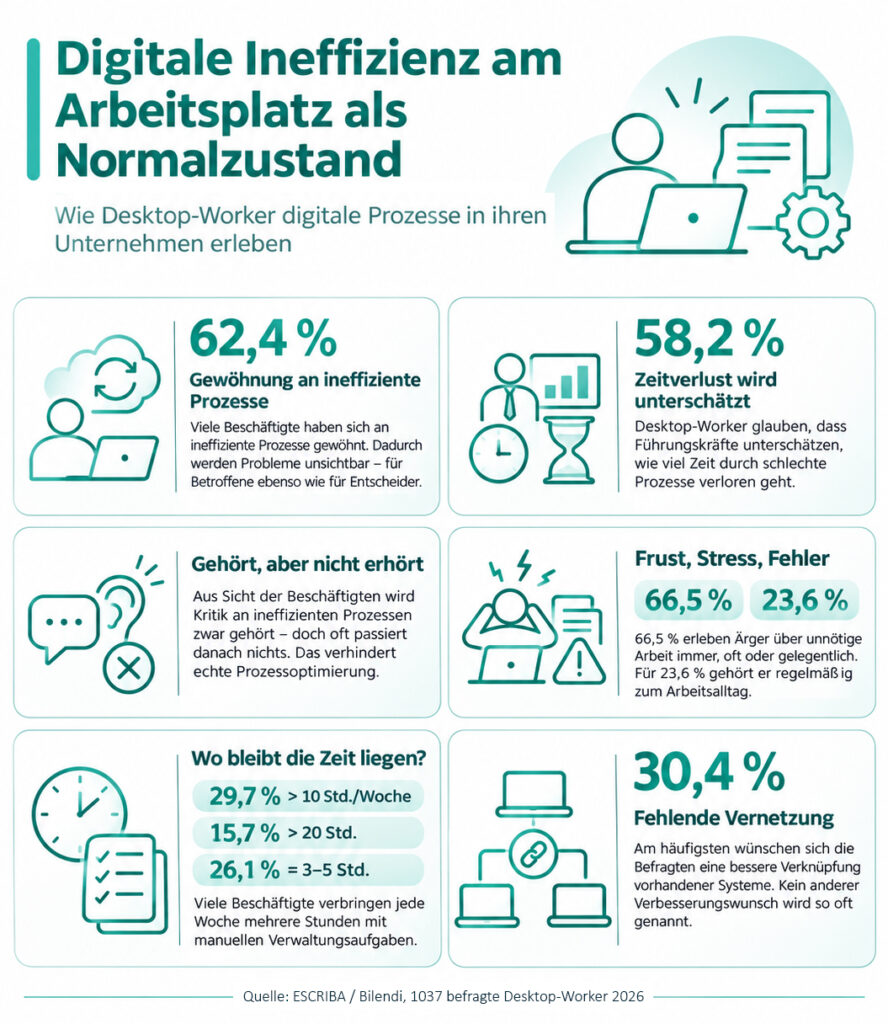
Anyone who has been transferring the same customer data from an email into two different systems for years eventually comes to see it as part of their normal work. At that point, hardly anyone notices that it’s actually a flaw in the workflow. This is precisely the mechanism described by the respondents: 62.4 percent agree with the statement that many employees in their company have become accustomed to inefficient processes. 23.5 percent even strongly agree, while only 15.9 percent disagree. No other statement in the section on digital efficiency receives this much agreement.
Important for context: The question did not ask about one’s own adaptation, but rather about that of “many employees.” The finding therefore describes a workplace atmosphere rather than a personal state. For employers, this does not make it any less problematic, because a workplace atmosphere is harder to change than a single process.
Another statistic suggests how this climate can arise. 52.6 percent say that while there is a lot of talk about efficiency in their company, little is actually being done about it. Anyone who has experienced multiple digitalization strategies or process workshops that resulted in little change in day-to-day operations will eventually stop expecting any improvement. While the survey does not prove a causal relationship, the figures paint a coherent picture. Added to this is the organization’s self-perception: 51.4 percent believe their company considers itself more efficient than it actually is. Only 21.3 percent disagree.
No one reports a problem that everyone considers normal. And a company that considers itself efficient does not look for it. This is where leadership comes into focus.
Why Do Managers Underestimate the Time Lost?
Managers typically see the result, not the process behind it. A finished quarterly report doesn’t reveal how many follow-up questions, system queries, and copied table values went into it. Consequently, 58.2 percent of desktop workers believe that managers underestimate how much time is lost due to poor processes. According to the findings, this is the second-highest agreement rate in the entire set of questions.
The survey does not measure what managers actually know, but rather what employees believe they are capable of. As an indicator of sentiment, however, the figure is still meaningful. Those who believe that the problem goes unnoticed at the decision-making level will eventually stop reporting it. The consequences extend beyond morale: If the time lost is underestimated, process improvements receive insufficient funding, staffing, and attention. The restructuring of an interface then loses out to projects that promise faster, more visible results.
Why do suggestions for improvement fall by the wayside?
It’s not just a matter of a lack of attention. 50.7 percent of respondents say that suggestions for improvement from employees are taken seriously at their company. However, 45.2 percent find that, for the most part, nothing changes when they bring up inefficient processes. What stands out here is the middle ground: 29.8 percent answered “neither.” Some may have never raised an issue, while others simply don’t know what became of their suggestion.
Taken together, these two figures reveal a clear pattern: In many companies, listening works well, but implementation falls short. This affects the culture of communication. 49.9 percent believe that inefficient processes are addressed openly too rarely. Anyone who has experienced twice that a suggestion goes unheeded will refrain from making one the third time.
It is also noteworthy what employees do not feel is lacking. When asked about the most urgent improvements, “greater openness to suggestions for improvement” came in last place with 10.4 percent. More than twice as many—24.0 percent—cited “clearer lines of responsibility.” From the workforce’s perspective, therefore, what is lacking is not so much someone who listens as someone who is in charge.
Where do desktop workers lose the most work time?
None of the tasks that take up time in everyday office life are particularly difficult. A data record is transferred to a second system, a document is searched for in the wrong folder, or a follow-up question is asked because the processing status isn’t visible anywhere. Individually, these take just a few minutes; together, they add up to hours.
According to their own estimates, 29.7 percent of desktop workers spend more than ten hours per week on manual administrative tasks, and 15.7 percent spend even more than 20 hours. Because administrative work isn’t automatically a waste of time, the survey also asked about avoidable effort: 43.6 percent lose three hours or more per week due to manual processes that could actually be digitized. 22.9 percent estimate this loss at at least six hours. Only 8.1 percent estimate that they lose no time at all.
The biggest time wasters are clear:
- Maintaining data across different systems: 60.1 percent say this takes up a great deal or quite a bit of their time.
- Searching for information and documents: 52.8 percent
- Manual documentation of work steps: 40.5 percent
- Meetings with no clear benefit: 39.7 percent
Meetings, often the first example cited in debates about workplace efficiency, thus rank only in the middle of the pack. The same pattern emerges in specific situations in everyday work life. 63.6 percent search, at least occasionally, for information that should actually be readily available. 57.7 percent have to ask colleagues about the status of a task because it isn’t transparently visible. 54.3 percent enter the same data multiple times into different systems, and 56.6 percent regularly perform tasks that they believe could be automated.
The cause is often the same: systems don’t exchange data, so employees end up acting as the interface. When official tools don’t help, many take matters into their own hands. 37.2 percent use, at least occasionally, tools, apps, or files that the company has not officially provided—such as personal Excel spreadsheets or cloud storage. While this saves time in individual cases, it creates new data silos and poses risks to data protection and information security.
How does a lack of efficiency in the workplace affect employees?
Poor processes affect morale. The survey specifically asked about feelings caused by inefficient processes. At least occasionally, respondents experience:
- Frustration over unnecessary work: 66.5 percent
- The feeling of not being as productive as they could be: 60.7 percent
- Stress: 60.2 percent
- Frustration: 59.0 percent
- The impression of not having enough time for their actual tasks: 51.6 percent
- Difficulty motivating themselves to work: 47.3 percent
In all cases, the response “occasionally” dominates. For the majority, therefore, frustration with processes is not a constant state, but it does recur regularly. The second-highest value also contradicts a widespread cliché: Those who feel they aren’t as productive as they could be want to accomplish more but are held back by processes. For HR managers, the motivation factor is particularly critical, because motivation is harder to regain than lost time.
The quality of work suffers as well. 87.4 percent of respondents have made a mistake at least once due to inefficient processes for handling documents or data. For most, this happens rarely; for 16.4 percent, however, it happens frequently or constantly. An incorrect address in a contract or a forgotten note in a personnel file creates new work—and that work is usually done manually again. The survey did not examine whether frustration with processes actually prompts employees to change jobs. However, one thing is clear: digital inefficiency is not purely an IT issue. It affects stress levels, motivation, and whether people find their work meaningful—and therefore belongs on the HR agenda as well.
Lack of Connectivity as the Core Problem of Digital Transformation in Companies
When processes run into problems, companies tend to purchase new software. Employees, however, see the most urgent need for action elsewhere. From a list of 13 areas, they could select up to three that they felt needed the most urgent improvement in their company:
| Area for Improvement | Percentage of mentions (Multiple mentions allowed) |
| Better integration of existing systems | 30.4 percent |
| Clear responsibilities | 24.0 percent |
| Better communication between departments | 22.9 percent |
| Better digital tools | 22.3 percent |
| Less manual data entry | 21.3 percent |
| More automation | 16.8 percent |
| Better training in the use of existing tools | 10.8 percent |
Better integration of existing systems leads the list by a good six percentage points. This aligns with the biggest time-wasters: Those who transfer data from one system to another every day want, above all, for the systems to handle this automatically. Of the four most frequently cited levers, three relate to connecting existing systems and people, while only one focuses on new tools. This does not mean that respondents reject new tools; they simply do not consider them to be the first thing that’s missing.
The bottom of the list is also revealing. Only 10.8 percent would like more training. For employers, this has a practical implication: A training initiative alone will do little to resolve dissatisfaction as long as the systems are not interconnected. This also helps explain an apparent contradiction: 56.6 percent regularly perform tasks that they believe could be automated, yet only 16.8 percent cite increased automation as the most urgent area for improvement. Respondents seem to sense that automation on disconnected systems is of little benefit. First, data must flow; only then can processes be automated.
How Companies Are Taking Action: Six Steps to Optimizing Workplace Processes
The survey does not paint a picture of employees who resist change. They want to work more productively, address problems, and know pretty well where the issues lie. What’s missing is the step from recognition to change. Anyone looking to optimize work processes in a company can start with the following points.
1. Making habituation visible
If you’ve been working a roundabout way for years, you no longer perceive it as such. That’s why an outside perspective is helpful—for example, from new employees, colleagues in other departments, or through a structured process review. A simple guiding question is enough: Which steps in the process would someone starting today not understand?
2. Bring Executives to the Desk
Appeals alone do little to bridge the perception gap. Firsthand experience, however, does. Managers can shadow a typical process for a day, from the first form to the final approval. Teams can spend two weeks tracking how often they enter data twice or search for information. Such figures are more persuasive than any general complaint.
3. Close the feedback loop
Every suggestion for improvement should receive a formal response, including who is responsible, a deadline, and the outcome. Even a reasoned “no” is better than silence. A public overview showing the status of all suggestions makes it clear that feedback makes a difference.
4. Addressing Frustration with Legal Proceedings as an HR Issue
Many employee surveys ask whether employees feel heard. More meaningful are specific questions, such as: How often do you have to search for information that should be readily available? And how many suggestions have actually led to a change? The answers provide HR and leadership with a solid foundation for setting priorities.
5. Connect First, Then Automate
Before making any new purchases, it’s worth taking stock: What data is being entered multiple times in different places, and where do employees serve as the point of contact? Eliminating these data silos first also undermines shadow IT and lays the groundwork for meaningful automation.
6. Rethink processes instead of just digitizing them
Digital transformation in companies is not about simply replicating poor processes one-to-one in software. The goal is to use digitalization to improve processes. That’s why the first step is a careful analysis of existing workflows and the redesign of future processes. It is crucial to involve employees in this change process, because they know the workarounds best.
How Software Supports Workplace Transformation
Software alone does not change habits. Digital transformation in companies can only succeed when technology, processes, and people work together. Once processes have been analyzed and reimagined, the right technical infrastructure can solve precisely the problems that respondents most frequently cite. The digital transformation experts at ESCRIBA therefore focus on four areas:
- Connecting Systems: The ESCRIBA Integration Server (EIS) operates in the background as a data hub between ESCRIBA applications and backend systems such as SAP HCM, SAP SuccessFactors, Workday, Dayforce, or Oracle HCM. Data is exchanged bidirectionally, ensuring that there is only one valid version of any given piece of information. Existing access rights for the connected systems are preserved.
- Automated document creation: Instead of static Word templates, ESCRIBA’s document management system uses dynamic document blueprints that pull data directly from leading systems. For example, at wind turbine manufacturer ENERCON, the time required to create an employment contract using ESCRIBA and digital signatures dropped from 6.25 hours to 45 minutes. The hiring process became 78 percent faster.
- Making Processes Transparent: In the HR ticketing system, every request becomes a ticket with clearly defined responsibility and a visible status. More than 100 typical HR service processes are supported by (partially) automated workflows. This eliminates the need to ask about the status of a request.
- Find documents quickly: The ESCRIBA ECAP eFile digital personnel file system consolidates all employee documents in one place, with full-text search capabilities—even for scanned documents—and an access control system that extends down to the document level.
All of these building blocks of digitalization directly address the survey findings: duplicate data entry, searching for information, a lack of transparency regarding processing status, and errors in document handling. They form the foundation for a sustainable digital transformation in the workplace.
Why Full Digitalization Is the Foundation for AI
Many companies are currently planning to deploy AI agents that can independently process tasks, create documents, or answer inquiries. Such systems require precisely what, according to the respondents, is often lacking: interconnected and usable data, clear lines of responsibility, and end-to-end processes.
“We’re currently talking a lot about the AI transformation. Our survey shows that digitalization—the indispensable foundation of this transformation—has clearly not been consistently implemented in many companies,” says Alexandra Sieron, Head of Marketing at ESCRIBA.
This is where the ESCRIBA Enterprise Agent Network (EAN) comes in. The AI-powered automation platform connects systems such as SAP, SuccessFactors, and Workday at the process level and makes it possible to model agent networks in a graphical editor. Data sovereignty remains entirely with the company, and every action is traceable via an audit trail. This allows AI to actually take on tasks, such as classifying incoming documents, answering questions about company agreements with references to the original document, or providing transparent updates on the processing status.
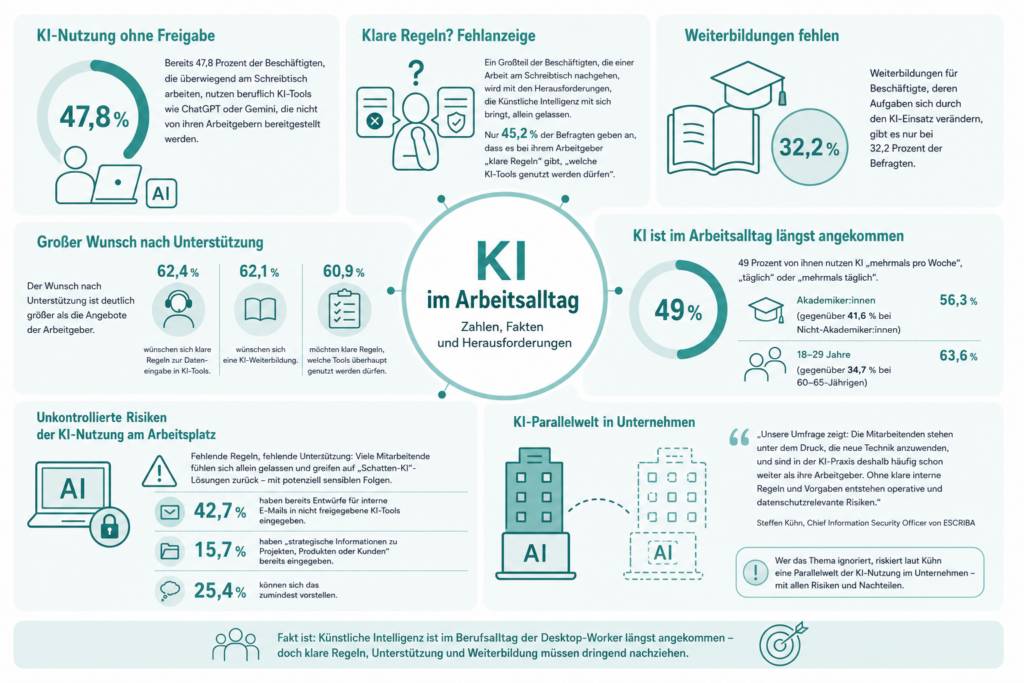
This is also a response to “shadow AI.” According to the ESCRIBA white paper “The AI Support Gap,” 47.8 percent of desktop workers use AI tools that their employer has not provided. Anyone who copies sensitive data into a freely available chat tool to save time is simply replacing one inefficiency with a new risk. Integrated, approved AI applications in a networked system environment eliminate the need for such workarounds.
Conclusion: Not only identify inefficiencies, but also eliminate them
The ESCRIBA survey shows that, despite software tools and digitalization, workplace efficiency remains a neglected issue. This is because manual processes and media breaks continue to slow down desktop workers in particular as they perform their tasks. But instead of eliminating these inefficiencies, both employees and supervisors are getting used to them. As a result, digital inefficiency is becoming the norm in many companies. At the same time, managers underestimate the resulting loss of time. Employees feel the consequences: Not only do they lose work time and make mistakes, but they also suffer from frustration and declining motivation.
As the ESCRIBA survey shows, the respondents themselves know where the problems lie. First and foremost, they don’t want even more tools to lighten their workload, but rather better integration of existing systems, followed by clearer lines of responsibility. For digitalization in the workplace, this means: Anyone who wants to optimize work processes and take process optimization seriously should identify inefficiencies, close the feedback loop, connect systems, and rethink workflows. This not only leads to greater efficiency in the workplace but also lays the foundation on which AI can truly take over tasks within the company. That’s why ESCRIBA supports companies on this journey from digitalization to AI transformation—not only by providing suitable tools but also by seamlessly integrating them with the existing software infrastructure.