

How can companies safely integrate AI into their existing HR system landscape without replacing their primary HCM system? We explain, step by step, how to implement AI features using the ESCRIBA Enterprise Agent Network (EAN) in SAP HCM, SAP SuccessFactors, and Workday—and what benefits this brings to HR operations.
Stay up to date on AI automation and process digitization, and follow ESCRIBA on LinkedIn.
Geschätzte Lesedauer: 15 minutes
In short: HR software with AI capabilities only realizes its full potential when the AI directly accesses approved HR data and defined processes, rather than operating in isolation within a public chat window. The ESCRIBA Enterprise Agent Network (EAN) is an AI-powered automation platform that connects to SAP HCM, SAP SuccessFactors, Workday, and any REST interfaces via pre-built connectors. AI modules for classification, forecasting, anomaly detection, semantic search, and HR agents are integrated into existing workflows via a graphical editor without deep code—multi-tenant, with an audit trail at the node level, and without vendor lock-in.
Overview
- Why HR Software with AI Capabilities Is Now a Must
- Native AI in SAP SuccessFactors and Workday—and Where the Gaps Lie
- What Is the ESCRIBA Enterprise Agent Network (EAN)?
- Here’s How to Implement AI Features in Seven Steps
- HR software with AI features for SAP and SAP SuccessFactors
- HR Software with AI Features for Workday
- HR software with AI capabilities in the cloud, on-premises, and in hybrid environments
- Real-world examples: workforce management, turnover forecasting, and HR agents
- The Benefits of EAN at a Glance
- AI Governance: What Employees Expect from AI in HR
- Conclusion
- FAQ
Why HR Software with AI Features Is Now a Must
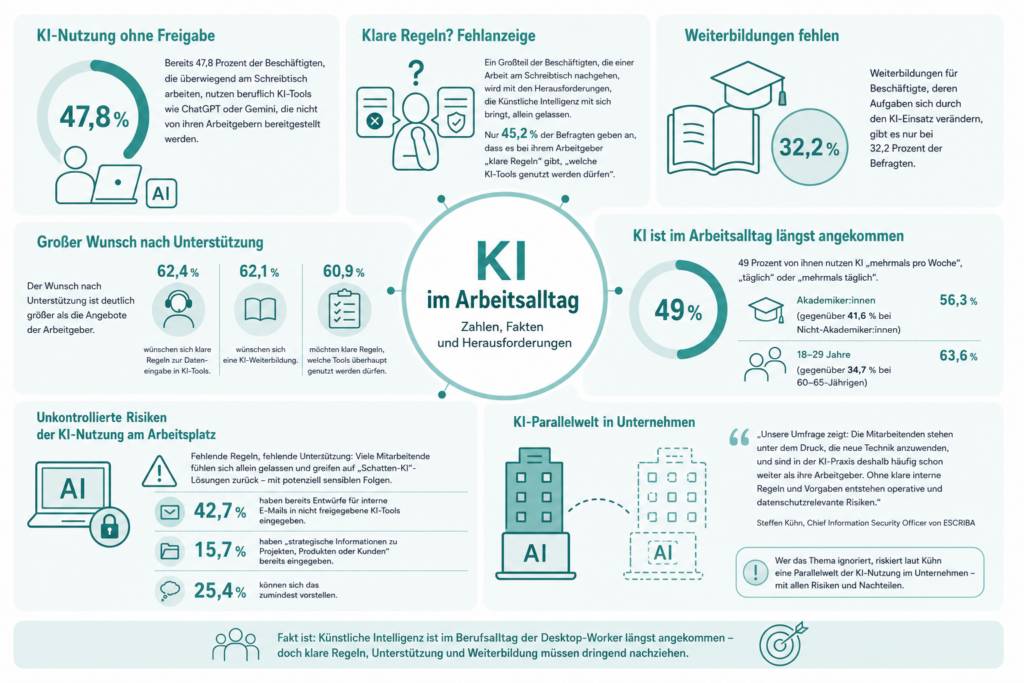
Artificial intelligence has long since become part of everyday work life—and faster than many companies can react to it. In June 2026, the market research institute Bilendi, commissioned by ESCRIBA, investigated how AI is changing the world of work and what this means for employers and employees. The study surveyed 1,037 employees in Germany—most of whom work at a desk—about AI use in the workplace. The results: 49.0 percent use AI several times a week, daily, or multiple times a day, and 60.3 percent use it significantly more often than they did twelve months ago.
A critical issue here is that 47.8 percent of employees use AI tools that have not been approved by their employer. This is referred to as “shadow AI.” Among shadow AI users, 12.3 percent have already entered HR or applicant data into unauthorized tools, and another 17.5 percent can imagine doing so. This poses a serious risk, especially for HR departments that handle highly sensitive employee data.
At the same time, the study shows that the leap to true process automation has yet to be made: While 71.4 percent use AI for research, only 28.5 percent are willing to create and use AI agents. These agents can independently handle individual steps of an HR process. This is precisely where HR software with AI capabilities comes in: It enables clearly defined AI use cases to be implemented in compliance with regulations, rather than allowing uncontrolled use of AI tools to occur in the background.
“The true potential of AI only unfolds when I can use, analyze, and evaluate AI-supported data in a secure environment. This requires connections to the data systems used in the respective field of work—and corresponding data quality,” says Dr. Juergen Erbeldinger, founder and CEO of ESCRIBA.
Native AI in SAP SuccessFactors and Workday—and Where the Gaps Lie
The major HCM providers are consistently advancing their own AI strategies. With Joule, SAP is integrating a generative AI assistant into SAP SuccessFactors that, for example, creates job descriptions, processes leave requests, and updates employee data. Joule Agents also execute multi-step HR workflows. Some of these features are so-called “premium AI capabilities,” for which AI Units must be purchased. With Illuminate, Workday relies on AI agents for HR and finance and, via an Agent Gateway using protocols such as the Model Context Protocol (MCP), also opens its platform to agents from partners.
These native AI features are valuable, but they primarily function within their respective systems. In practice, however, many companies operate in multi-system environments: SAP HCM alongside SAP SuccessFactors, Workday alongside SAP, supplemented by Dayforce, Oracle HCM, Archive, applicant tracking systems, or Office applications. Added to this are HR-specific requirements that standard features often fail to address, such as complex document workflows with multi-level approvals, audit-compliant personnel files, or country-specific regulations.
The real challenge is this: Every multi-step workflow (loading, transforming, enriching, storing, and notifying) has, until now, required custom development. This is because enterprise systems do not inherently communicate with one another, business logic is constantly changing, and there is a lack of necessary transparency when errors occur. A cross-system AI automation platform closes exactly this gap.
What is the ESCRIBA Enterprise Agent Network (EAN)?
The ESCRIBA Enterprise Agent Network (EAN) is an AI-powered automation platform for the modular programming of data flows in HR backend systems. It extends the no-code and low-code approach of the ESCRIBA ECAP platform to all workflows, including microservices that were previously developed using deep code.
The platform is based on three key principles:
- Nodes: independent, reusable processing units with typed inputs and outputs
- Edges: connections between nodes where data transformations can be defined directly
- Graphs: fully modeled, executable pipelines consisting of multiple nodes—including conditional branches and a step-by-step debug mode
At its core are two types of functional modules:
| Connectors | Logic components |
| Integration with external systems such as databases, web services, and applications | Mapping of business rules and data processing |
| Integration of SAP, SuccessFactors, Workday, and any REST interfaces | Control of processes and workflows |
| Changes affect only the interface, not the business logic | AI blocks for classification, forecasting, and anomaly detection |
This clear separation is the key difference from traditional three-tier architectures consisting of a load adapter, processing layer, and write adapter, which are rigidly coupled and require extensive maintenance.
How is AI integrated into EAN?
In EAN, AI is not an add-on, but a first-class component of the platform with the following features:
- Generation via natural language: Nodes and graphs can be created using natural language descriptions.
- AI nodes with LLMs: Large language models with tool and function calling are used directly in workflows.
- Vector Databases and RAG: Semantic search enables answers drawn from policies and documents, with citations.
- Conversation Memory: Persistent context enables multi-step AI workflows.
- Model Context Protocol (MCP): External AI models and AI tools such as Microsoft Copilot can dynamically access graphs and nodes.
Important for regulated HR environments: AI agents built on the EAN platform remain independent of individual AI models. This avoids dependencies on external providers and the associated cost risks.
Here’s How to Implement AI Features in Seven Steps
What does the implementation of HR software with AI features based on EAN actually look like? The following process summarizes the steps involved.
1. Prioritize Use Cases
ESCRIBA recommends a step-by-step approach: Prioritize processes based on frequency, error susceptibility, and resource requirements; start with one or two clearly defined pilot areas; and then systematically expand successful approaches. Standardized, data- and document-based processes—such as contract drafting, ticket processing, master data maintenance, or deadline management—are well-suited for this.
2. Integrate HR systems
The technical foundation is the ESCRIBA Integration Server (EIS), a multi-system data hub for SAP HCM, SAP SuccessFactors, Workday, Dayforce, and other HR systems. Pre-built adapters are available for ERP and HCM systems. Other systems are integrated via REST API, SQL adapters, file adapters, or web services. Existing permissions and access rights in the source systems are taken into account when reading data.
3. Model the workflow in the graphical editor
Using drag-and-drop, nodes from the block library—which includes categories such as AI, Bus, Connector, Control Flow, Data Processing, ECM, File, Image, Script, and Web—are connected to form a graph. HR managers can define rules and workflows themselves without having to write code.
4. Add AI building blocks
AI nodes are inserted in areas where AI provides real added value—such as document classification, plausibility checks, forecasting, or natural-language responses. AI is used in a targeted manner and only when necessary—for example, only when a barcode is unreadable and OCR combined with AI-based document analysis is required.
5. Testing with the Live Debugger
The integrated debugger enables process-level quality assurance directly during the design phase and without the need for QA specialists.
6. Deployment and Provisioning
Deployment is based on ECAP and thus follows familiar processes. Each configured agent network automatically supports the industry standards REST API and MCP protocol. For example, an HR agent can be invoked from a company’s own applications or from within Microsoft Copilot.
7. Operate, Monitor, Expand
Each execution can be tracked at the node level, including results, timestamps, and status. Graph definitions are versioned and can be migrated. New requirements are implemented using additional building blocks, while existing processes remain unchanged.
HR Software with AI Features for SAP and SAP SuccessFactors
ESCRIBA is a certified SAP partner and also offers its HR software modules directly through the SAP Store. The ESCRIBA Integration Server has been certified by SAP for the sixth consecutive time. This confirms seamless and reliable data exchange on the SAP Business Technology Platform (BTP).
For AI implementation, this means that EAN connectors read HR master data and transaction data from SAP HCM and SAP SuccessFactors via standardized, certified interfaces and can write the results back. The HR processes remain in the primary SAP system, while AI logic, document logic, and workflows are intelligently integrated. Here’s an example from an EAN use case: Certain documents are stored via SAP ArchiveLink, in parallel with a standard storage path. This is achieved simply by adding an additional branch to the graph.
The EAN-based HR Agent is also designed for SAP: It enables chat-based queries and maintenance of HR data, thereby allowing users to access their own information and update data using natural language.
HR Software with AI Features for Workday
As a Workday software and channel partner, ESCRIBA offers two “Built on Workday”-certified apps available on the Workday Marketplace: the ESCRIBA Document Automation Connector and the ESCRIBA eFile Automation Connector. A preconfigured adapter connects ESCRIBA to Workday HCM and also enables bidirectional data exchange.
The integration can be configured quickly. First, the technical connection is established; then, the required data fields from the Workday APIs are linked in the connector without any programming. In addition, you can use details from ongoing Workday business processes as well as information from custom reports via Reports-as-a-Service. Once the data fields are connected, they are available for documents and for controlling business processes with just a few clicks—and thus also serve as a data source for AI nodes in EAN graphs.
An example of efficiency: The ESCRIBA Document Automation Connector can save up to 78 percent of the time compared to manual document creation. Since Workday itself relies on MCP via an Agent Gateway, EAN’s native MCP support fits well into the agent strategy of Workday customers.
HR software with AI capabilities in the cloud, on-premises, and in a hybrid environment
Many companies still run SAP HCM on-premises, while SAP SuccessFactors or Workday run in the cloud. Cloud-based HR software with AI capabilities must therefore be able to handle hybrid scenarios. The ESCRIBA Integration Server supports parallel connections both on-premises and in the cloud. This allows data storage, document management, and metadata to be maintained in the cloud or on the customer’s premises, as desired.
Data sovereignty is crucial for AI deployment: With EAN, data sovereignty remains entirely in-house; for external AI systems, only the request and the result are visible—internal data and process logic remain protected. Role-based access controls and European hosting options also support GDPR-compliant processing of personnel data. The platform is multi-tenant, follows a REST API-first approach, and can be integrated into existing enterprise infrastructures without vendor lock-in.
Real-World Examples: Personnel Management, Turnover Forecasts, and HR Agents
HR Software with AI Features for Personnel Management
In human resources management, AI is particularly useful in areas where there are large volumes of documents and routine tasks:
- Document Validation: A graph loads an employee’s documents, classifies them using AI, checks them for completeness and plausibility against predefined rules, and writes the results back to the HR system. Documents that cannot be clearly classified are placed in a clearing box for manual review.
- Smart Inbound Processing: Incoming documents are classified, assigned to the correct personnel file, and trigger follow-up processes—for example, a submitted birth certificate can trigger changes to master data and processes such as parental leave or child allowances.
- Automated Contract Workflow: From document receipt to audit-compliant storage—scanned documents are automatically assigned, missing forms are generated, completeness is verified using AI, and the final document is filed in the personnel file.
- Document Generation: Contracts, certificates, and other documents are generated automatically from structured data.
HR software with AI capabilities for forecasting employee turnover
An HR business partner wants to know which teams are at increased risk of turnover and what factors contribute to it. An AI graph aggregates data on absences, contract durations, promotions, salary band changes, and training participation to identify notable patterns. Technically, EAN graphs retrieve data from SAP HCM, SAP SuccessFactors, Workday, or Dayforce via reusable connectors, transform it, and enrich it; AI nodes supplement this with forecasting, pattern recognition, and anomaly detection. The result is a report that the HR business partner can discuss directly with executives.
The advantage over analyses of individual systems: In practice, turnover factors are rarely found in just one system. EAN consolidates the data across all systems. It is important to handle this data responsibly. This is because forecasts should provide impetus for action at the team and organizational levels and be clearly communicated. As the ESCRIBA survey shows, 60.4 percent of desk-based employees want assurances that AI will not be used to monitor their performance.
HR Agents and HR Assistants in Self-Service
- HR Assistant with a Knowledge Base: When asked, “What rules apply to remote work two days a week?” the assistant searches the company policy and provides a clear answer with a reference to the original document—technically using Vector databases, RAG, and tool calling.
- HR Agent for Life Events: If an employee writes, “I became a father last week—what do I need to do now?”, the agent identifies the issue, provides information about parental leave and benefits, requests supporting documentation, and initiates follow-up processes such as the parental leave application, notification to payroll, and updating the personnel file.
- Chat Feature in the File: An AI assistant answers questions about documents in the personnel file in compliance with the GDPR, eliminating the need to read documents manually
An Overview of the Benefits of EAN
| Benefit | What this means in practice |
| Lower integration costs | 60 percent lower integration costs thanks to reusable EAN modules |
| Lower maintenance costs | Up to 50 percent lower maintenance costs compared to traditional web service architectures |
| Faster implementation | Existing nodes are reused; wait times for backend resources and project durations are reduced |
| No deep coding required | Workflows can be built, optimized, and automated without any programming knowledge |
| Transparency and Compliance | Node-level audit trail, versioned graph definitions, step-by-step debugging |
| Data Sovereignty | Only the call and the result are visible to external AI systems |
| Multisystem Capability | REST API and MCP out of the box, compatible with SAP, SuccessFactors, Workday, ServiceNow, and Microsoft Copilot |
| Scalability | Supports multiple clients; performs well with large graphs and large files |
There is also an organizational benefit: Back-end developers can focus on product development, while project implementations no longer require dedicated developers. “EAN helps HR departments drive AI and digital transformation in a targeted manner within a secure system,” says ESCRIBA CTO Jens Rohnstock.
AI Governance: What Employees Expect from AI in HR
Technology alone is not enough. The ESCRIBA AI study reveals a gap of approximately 22 percentage points on average between the level of AI support employees want and what they actually receive. 62.4 percent want clear rules for data entry, 60.9 percent want clear guidelines for using tools, and 62.1 percent want training when AI changes their tasks. In reality, only 32.2 percent receive such training.
Four guidelines can be derived from this for the implementation of HR software with AI capabilities:
- Approved alternatives instead of bans: Rules are only effective if employees are given a good, integrated alternative to freely available tools.
- Establish risk-based human oversight: Only 30.1 percent trust automation without direct human review. Clearing boxes, approval steps, and an audit trail make oversight transparent.
- Promote transparency: Disclose what data is being processed and for what purpose, especially in analyses such as turnover forecasts.
- Involve employees and employee representatives early on: This improves the quality of use cases and increases acceptance.
Conclusion
HR software with AI capabilities is effective only if AI operates not alongside, but within the existing HR system landscape. The native AI offerings from SAP and Workday are an important building block, but they often do not fully cover multi-system landscapes and HR-specific processes such as document creation, file validation, or cross-system analytics. The ESCRIBA Enterprise Agent Network (EAN) closes this gap: As an AI-powered automation platform, it connects SAP HCM, SAP SuccessFactors, Workday, and other systems via reusable connectors and integrates AI nodes for classification, forecasting, semantic search, and HR agents directly into workflows.
ESCRIBA’s implementation of the EAN follows a clear path: prioritize use cases, integrate systems, model graphs, add AI components, test, deploy, and continuously expand. Companies benefit from lower integration and maintenance costs, faster project completion, full traceability, and data sovereignty. At the same time, they create the approved, secure alternative that employees want and curb the use of shadow AI. As a certified partner of SAP and Workday, ESCRIBA provides the appropriate integration foundation for this.
Would you like to integrate AI capabilities into your HR system landscape? We can help you with the planning and implementation. Schedule a no-obligation initial consultation with us.
FAQ
The ESCRIBA Enterprise Agent Network connects SAP HCM and SAP SuccessFactors via certified interfaces. The SAP-certified ESCRIBA Integration Server serves as a data hub on SAP BTP. In the graphical EAN Editor, connectors and AI nodes are linked to workflows that read data, process it using AI, and write the results back.
Yes. ESCRIBA is a Workday partner and offers “Built on Workday” apps on the Workday Marketplace. Data is integrated without programming via a preconfigured adapter and Workday APIs, including Reports-as-a-Service. This also makes the ESCRIBA Enterprise Agent Network, with its AI capabilities, available for Workday.
Yes. ESCRIBA’s EAN graphs aggregate data on absences, contract durations, promotions, salary band changes, and training participation from systems such as SAP SuccessFactors or Workday. AI nodes detect patterns and anomalies and provide HR business partners with reports on teams at increased risk of turnover.
ESCRIBA’s EAN is designed with data sovereignty in mind: External AI systems can only see the request and the result, and every execution is traceable via an audit trail. Role-based access controls and European hosting options support GDPR-compliant processing.
No. HR managers assemble modules using drag-and-drop and define rules; agents can even be set up via AI chat.
No. ESCRIBA’s EAN-based AI agents are independent of individual AI models. Furthermore, external AI tools such as Microsoft Copilot, Claude, or ChatGPT can natively access the agent networks via MCP.